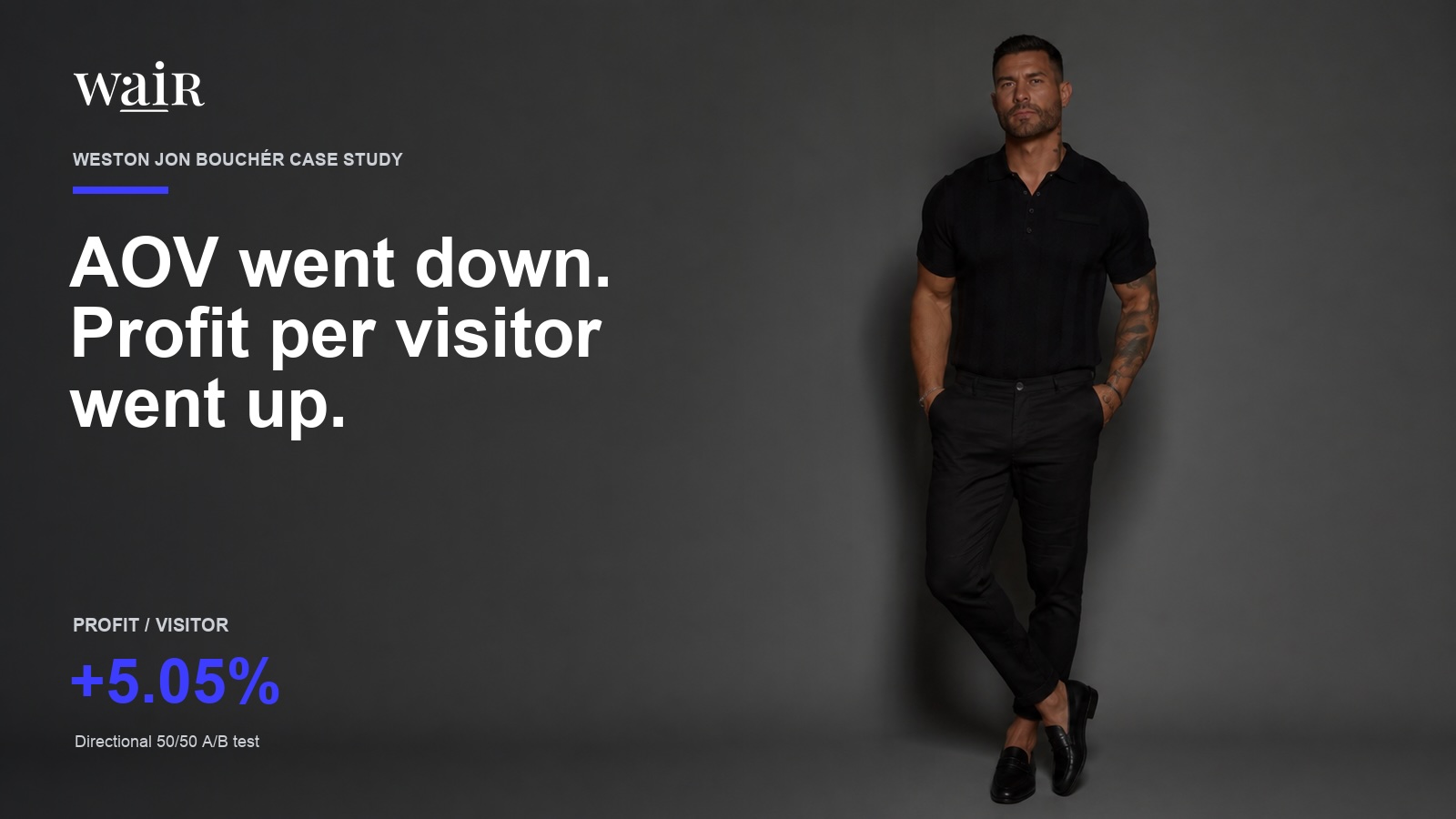
AOV Went Down. Profit per Visitor Went Up.
Ecommerce teams are trained to celebrate a higher average order value. Bigger carts usually look like better carts. But apparel is different.
A shopper who is unsure about size may add two versions of the same product to the cart, planning to keep one and return the other. That can make AOV look healthy at checkout while creating more work and cost after the order is placed.
So what happens when shoppers receive size guidance before they buy?
Weston Jon Bouchér recently ran a controlled 50/50 A/B test to find out. For 30 days, half of the brand's shoppers had access to WAIR and half did not. The test was conducted using Intelligems.
The WAIR experience directionally outperformed the control on three metrics that matter to ecommerce leaders:
- Conversion rate increased 6.80%, moving from 3.63% to 3.88%.
- Revenue per visitor increased 4.90%, moving from $7.14 to $7.49.
- Profit per visitor increased 5.05%, moving from $5.91 to $6.21.
At the same time, average order value declined 1.78%, from $196.37 to $192.88.
A lower AOV is not automatically a worse outcome
If AOV were the only metric on the dashboard, the WAIR experience might look slightly weaker. The average order was about $3.49 smaller.
But visitors who had the ability to use WAIR converted at a higher rate and generated more revenue and profit per visit. The test's estimated monthly impact was 172 additional orders and $20,825 in additional profit.
Taken together, the results point toward a more useful question:
Are we trying to maximize the size of each cart, or the economic value of each visitor?
For apparel brands, often a lower AOV is preferred as it can be associated with reduced size sampling (bracketing). This is because shoppers add fewer extra sizes when they feel more confident about which one to buy.
That distinction matters. A larger order is only more valuable if the items stay sold.
Evaluate fit technology through session economics
Size recommendations are often treated as a narrow PDP feature. The Weston Jon Bouchér test shows why ecommerce directors should evaluate them across the full shopping session.
A useful test should look beyond engagement with the size tool itself. It should consider:
- Whether more visitors complete a purchase.
- How much revenue each visitor generates.
- How much profit each visitor generates.
- Whether AOV changes and why.
- What happens to returns and kept-item value after the return window closes.
No single metric tells the whole story. Conversion without profit can hide expensive growth. AOV without return context can reward size sampling. Revenue without visitor context can make it difficult to separate traffic growth from a better shopping experience.
Revenue per visitor and profit per visitor create a clearer view because they connect the outcome to every person who reached the store, not only the people who completed an order.
For an ecommerce director, that framing changes the optimization conversation. Traffic has already been paid for or earned. If the same visitor pool can directionally produce more completed orders and more profit, the experience deserves attention even when the average basket is a little smaller. The metric hierarchy should follow the business outcome, not tradition.
The goal is confident, profitable purchases
WAIR is designed to help shoppers choose a size before uncertainty becomes abandonment, size sampling, or a preventable return. For the ecommerce team, the value is not simply that a recommendation was delivered. The value is whether that guidance improves the economics of the session.
In this test, the WAIR variant produced higher conversion, revenue per visitor, and profit per visitor while AOV moved slightly lower.
That is not an argument for lowering AOV. It is an argument for interpreting AOV in context.
Sometimes a smaller cart is a sign that the shopper made a more confident decision. And sometimes the better ecommerce outcome is not the biggest order. It is the visit that produces more profit.
See what WAIR could reveal about your ecommerce sessions.


Want to be notified of our newest episodes?
Subscribe to our Podcast!