What Happens when Shoppers' Profiles DO NOT Match the Fit System
A brand can attract exactly the right shopper and still build clothing for the wrong body.
That is the fit problem hiding inside many apparel businesses.
Marketing creates an audience. Branding creates an expectation. Product development then has to deliver clothing that works for the people who respond to that promise.
But if the sizing strategy is built around a generic global standard instead of the brand’s actual shopper population, the connection breaks down.
The result is predictable: customers are attracted to the brand, find products they like, choose the size they believe should fit, and still experience inconsistent or disappointing fit.
We examined one anonymized men’s golf apparel population to understand how large this gap can become.
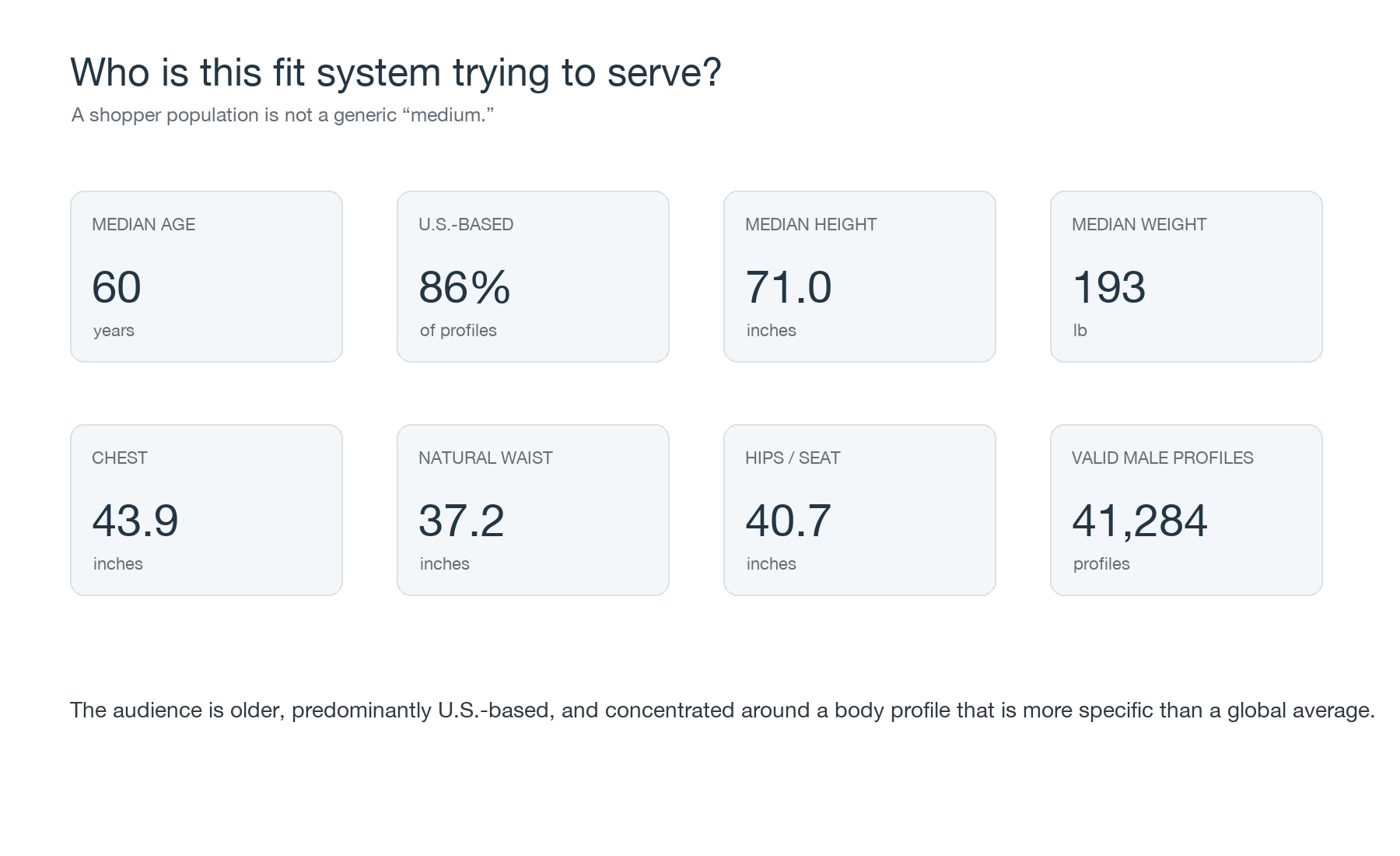
The brand serves a predominantly U.S.-based male audience, with approximately 86% of identified shoppers located in the United States. The population is also notably mature:
- Median age: 60
- Approximately 66% of shoppers are age 55 or older
- Median height: 71 inches
- Median weight: 193 pounds
- Median chest: 43.9 inches
- Median natural waist: 37.2 inches
- Median hips/seat: 40.7 inches
The data included more than 41,000 valid male profiles for the three-dimensional fit analysis.
This is not an abstract global average. It is a specific shopper population with a specific demographic and body profile.
The audience is not defined by height alone
At first glance, this population could look relatively ordinary.
The median height is 71 inches, and the median inseam is approximately 30.4 inches. If a brand looked only at height and inseam, it might conclude that a standard men’s fit block is sufficient.
But height does not tell us how a body is distributed.
The central 80% of the population ranges from approximately:
- 68 to 75 inches in height
- 161 to 240 pounds in weight
- 40.9 to 48.4 inches in chest
- 33.8 to 42.2 inches in waist
- 38.2 to 44.6 inches in hips/seat
That is a wide range of body volume, particularly through the waist and torso.
A shopper at the lower end of that waist range is not simply a smaller version of a shopper at the upper end. The garment needs to accommodate a different relationship between chest, waist, and seat.
That relationship is where fit systems often fail.
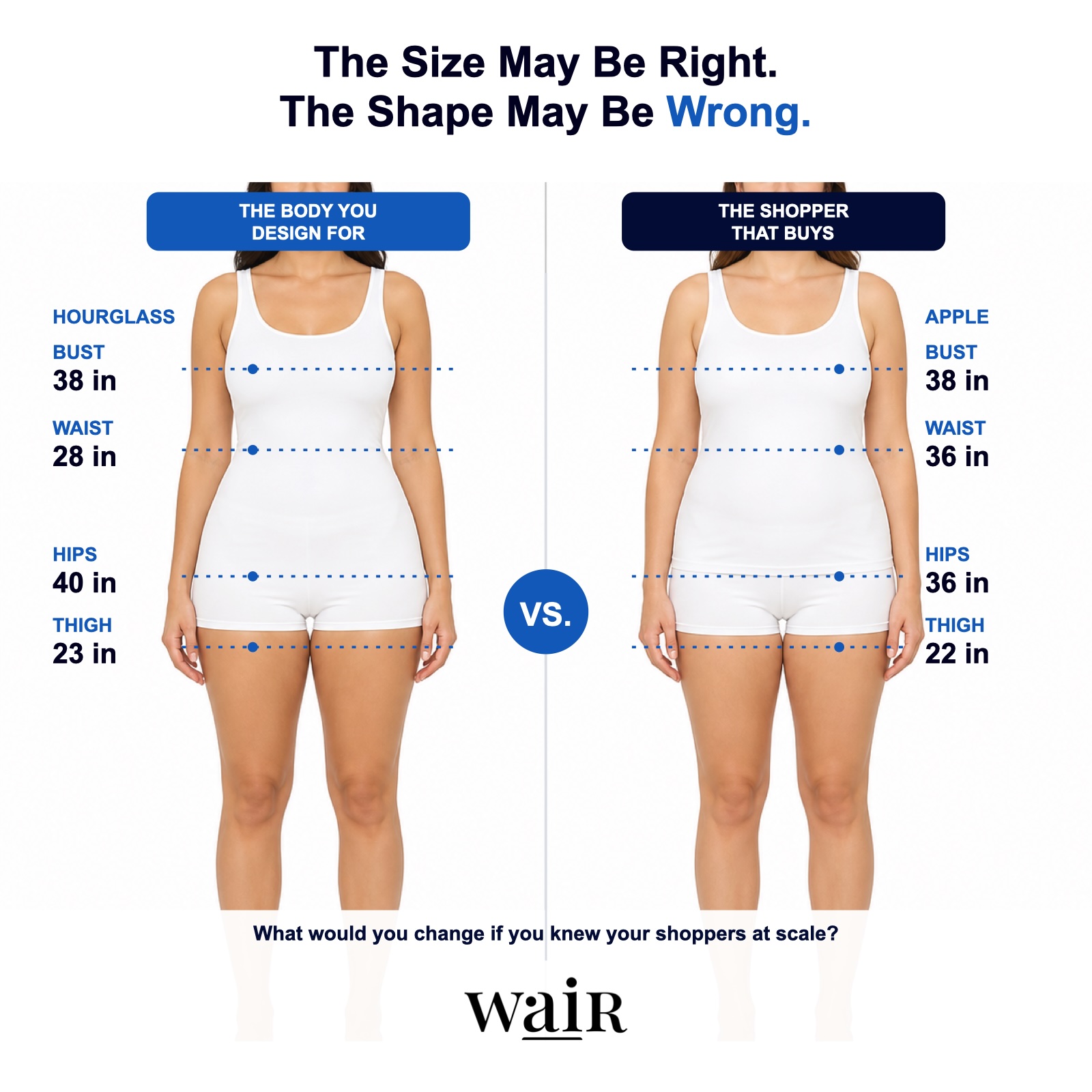
The body shape is more varied than the size label suggests
The population’s median chest-to-waist difference is approximately 6.6 inches. The median hips-to-waist difference is approximately 3.4 inches.
Those averages conceal substantial variation.
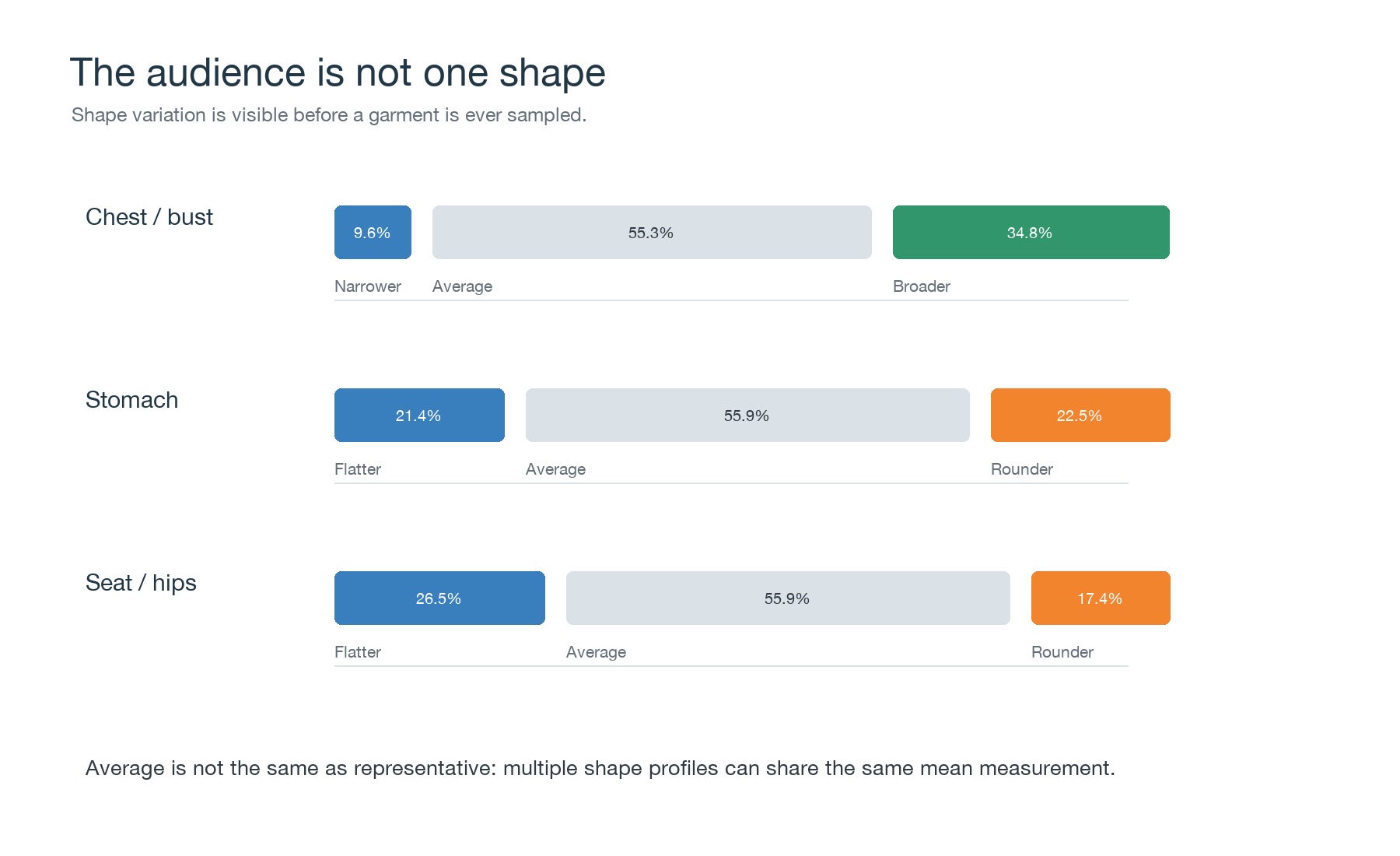
Approximately 35% of profiles are categorized as having a broader chest, while approximately 10% are categorized as having a narrower chest. Only about 55% fall into the average chest category.
At the stomach, approximately 22.5% of profiles are categorized as rounder and approximately 21.4% as flatter. That means nearly 44% of the population falls outside the average stomach profile.
At the seat, approximately 26.5% are categorized as flatter and approximately 17.4% as rounder.
This is a population with multiple fit needs:
- Broader and narrower chests
- Average, rounder, and flatter stomach profiles
- Average, flatter, and rounder seat profiles
- Significant variation in waist circumference at similar heights
Yet most traditional sizing systems reduce this complexity to a single size label.
That is the problem.
A size label tells a shopper where to start. It does not tell a product team which body proportions the garment must accommodate.
The Alvanon comparison makes the gap visible
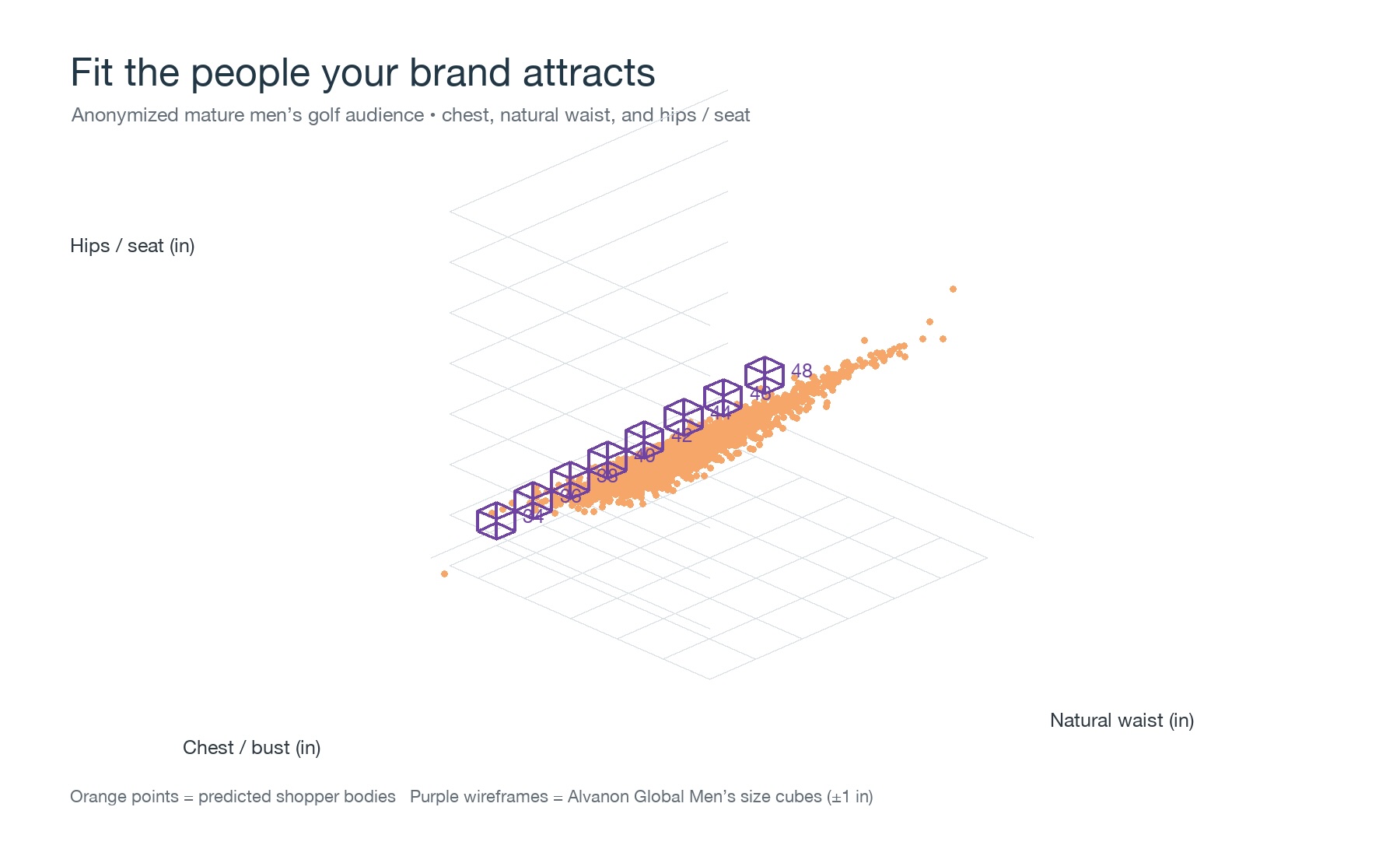
We overlaid the Alvanon Global Men’s size standards onto the population using three measurements:
- Chest girth
- Natural waist girth
- Hips/seat girth
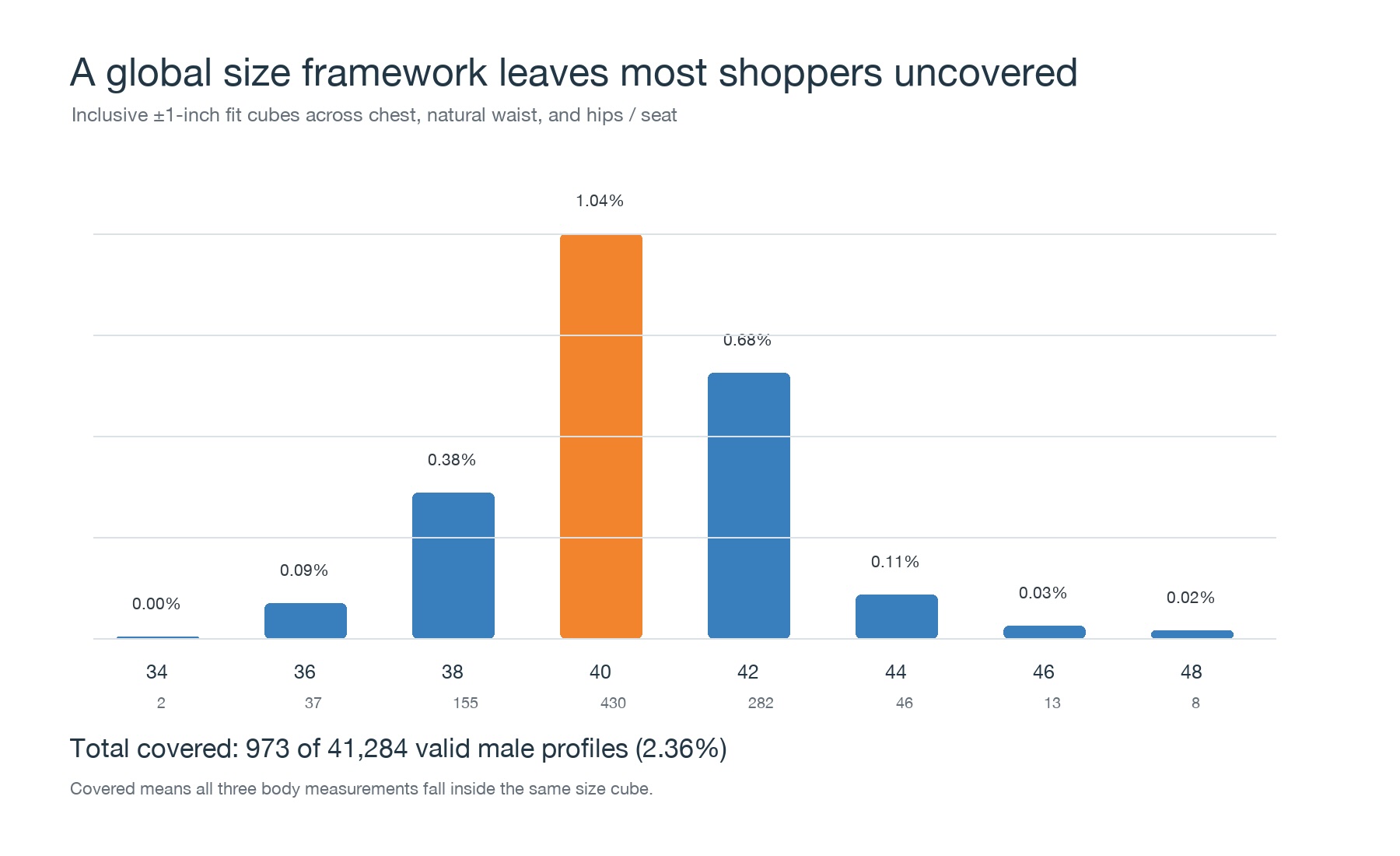
A profile counted as covered when all three measurements fell within an inclusive ±1-inch cube around an Alvanon size-label center.
Across the full set of eight size cubes, only 973 of the 41,284 valid male profiles were covered.
That represents approximately 2.36% of the population.
The individual size results were:
- Size 34: 0.00%
- Size 36: 0.09%
- Size 38: 0.38%
- Size 40: 1.04%
- Size 42: 0.68%
- Size 44: 0.11%
- Size 46: 0.03%
- Size 48: 0.02%
The largest single coverage point was size 40, but it covered only about 1% of the valid male population.
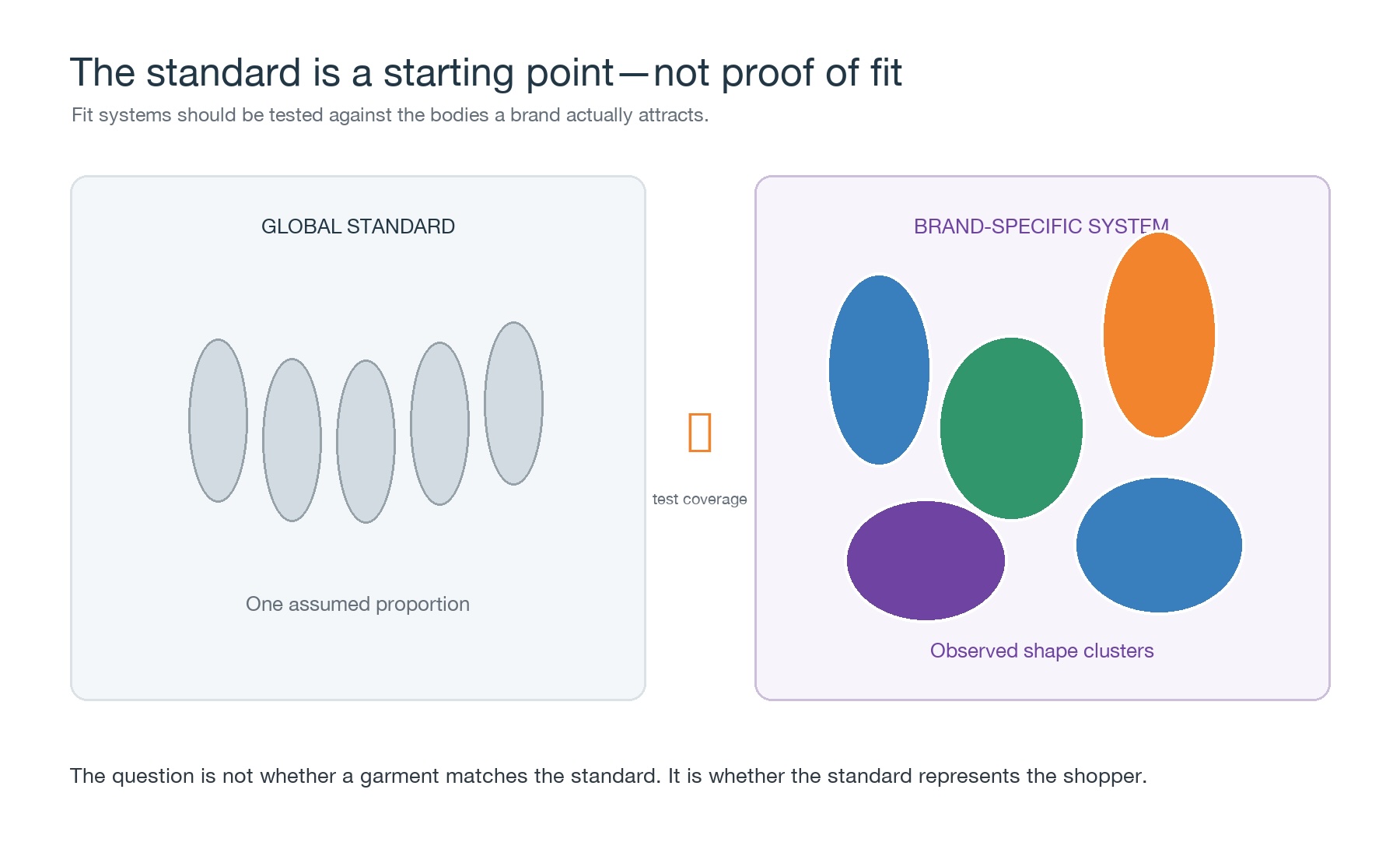
This does not mean the Alvanon standard is inherently wrong. It means the standard, by itself, does not describe this brand’s shopper population well enough to serve as a complete fit system.
The standard may provide useful size centers. It does not provide brand-specific proportions.
The marketing promise and the product reality can diverge
A mature male golf audience is not a generic audience.
These shoppers may be drawn to a brand because it represents performance, confidence, polish, technical credibility, or a particular lifestyle. They may expect clothing that works across the golf course, clubhouse, travel, and everyday life.
That positioning attracts a specific customer.
But the product must then account for the bodies within that customer base.
If the brand’s sizing strategy assumes a narrower range of torso shapes, less waist variation, or a different relationship between chest and seat, the marketing promise becomes disconnected from the product experience.
The shopper is not asking whether the garment matches a global standard.
The shopper is asking whether the garment fits him.
And “fit” may mean:
- Does the shirt close comfortably through the waist?
- Does the chest have enough room without making the body too loose?
- Does the polo hang correctly through the midsection?
- Does the jacket accommodate the stomach without becoming oversized in the shoulders?
- Do trousers fit both the waist and seat?
- Does the garment move during a golf swing?
These questions cannot be answered by chest measurement alone.
The fit system needs to start with the audience
The solution is not necessarily to create dozens of new sizes.
A better approach may involve:
- Brand-specific body population analysis
- Multiple fit blocks
- Proportion-based grading
- Separate torso and lower-body shape strategies
- More precise size recommendation logic
- Product-category-specific fit models
- Ongoing measurement of fit coverage
For this audience, a brand might need to understand how many shoppers are broader through the chest, how many carry more volume through the waist, and how those shapes change across size ranges.
The objective is not to reject global standards.The objective is to stop treating them as the end of the process.
Brand-specific shopper data tells the product team where that starting point needs to change.
Fit is relative to the people a brand attracts
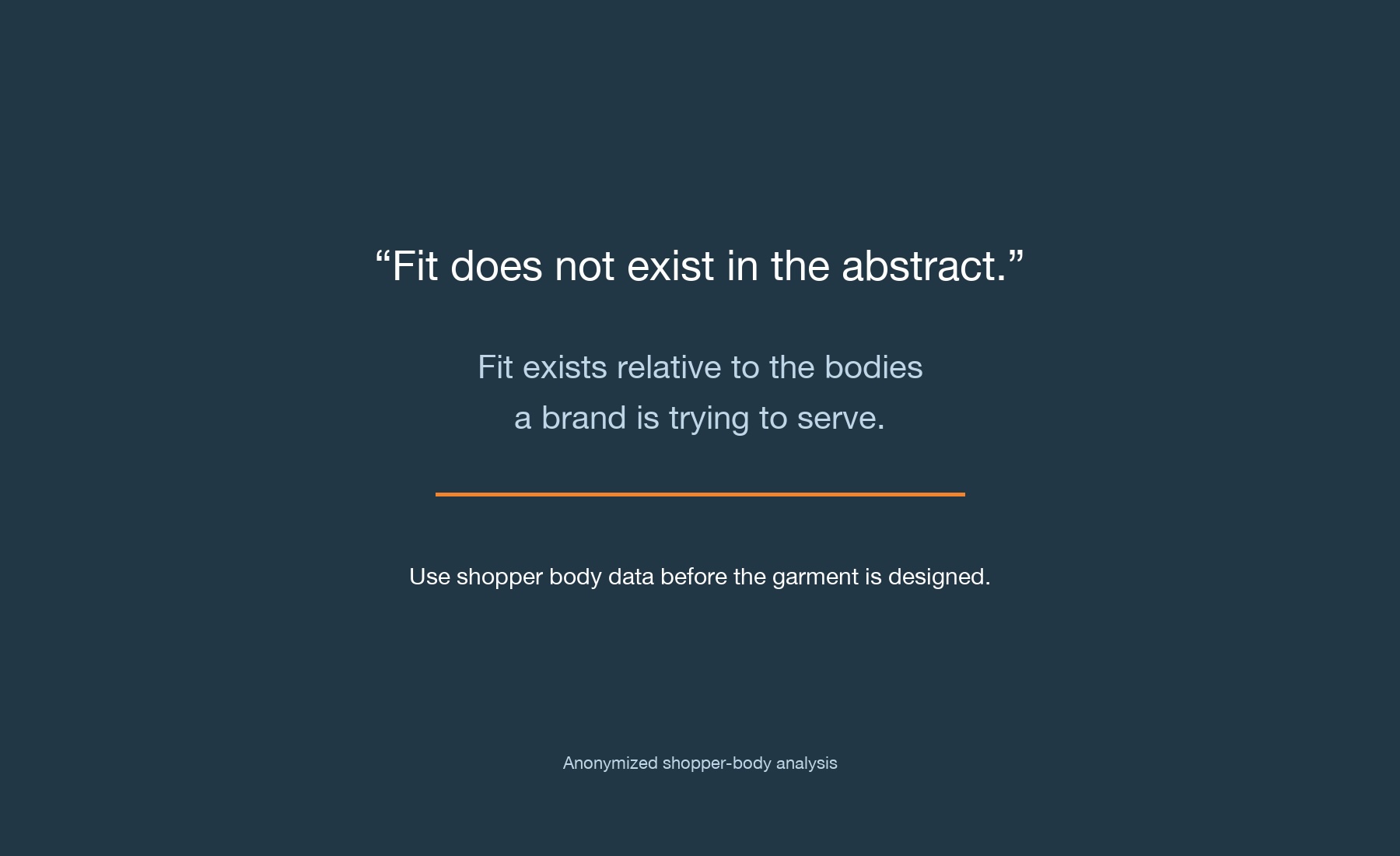
The central lesson is simple: A brand can successfully attract a shopper demographic while failing to build a sizing system for that demographic.
Marketing determines who enters the funnel. Product development determines whether the product delivers on the promise.
If those two systems are not connected, poor fit is not a mystery. It is a structural outcome.
The right question is not: “Does this body fit the standard?”
The right question is: “Does our standard represent the bodies we are asking to buy from us?”
For this anonymized mature men’s golf population, the answer appears to be no.
And that is exactly why shopper body data belongs at the beginning of the fit process, not at the end.



Want to be notified of our newest episodes?
Subscribe to our Podcast!