A Smarter Way to Measure eCommerce ROI: Kept Items Per Session
Most apparel ecommerce teams are trying to solve the same hard problem: drive more revenue without creating more operational and margin pressure after the sale.
That sounds simple, but it is not.
Conversion rate, return rate, average order value, gross margin, inventory availability, and customer satisfaction all move together. A brand can increase conversion and still fail to create meaningful profit if too much of that new order volume comes back. A brand can reduce returns and still miss revenue goals if shoppers hesitate, lose confidence, and leave the site without buying.
That is why apparel brands need a better way to evaluate fit technology.
At WAIR, we recently analyzed March 2026 session data across several apparel brands to better understand how personalized size recommendations impact ecommerce performance. The goal was not to cherry-pick one metric or make an overly broad claim. The goal was to evaluate the full ecommerce equation more practically.
The most useful metric we found was simple:
Kept items per session.
This measures how many purchased items shoppers actually kept for every site session. It combines two of the most important ecommerce outcomes into one number:
- Did the shopper buy?
- Did the shopper keep what they bought?
That makes it a much better ROI metric than conversion rate or return rate alone.
What We Analyzed
To better understand WAIR’s impact, we analyzed March 2026 session data across 4 mid-market apparel brands. In total, the dataset included approximately 6.8 million shopper sessions, 76,000+ orders, 192,000+ purchased line items, 49,000+ returned line items, and 1,000+ fit reviews.
Rather than focusing on one isolated metric, like conversion rate or return rate, we looked at the full ecommerce journey: whether shoppers engaged with WAIR, whether they purchased, whether they accepted the size recommendation, whether they reviewed the fit as great, and whether the purchased item was ultimately kept.
That broader view led us to a more practical ROI metric: kept items per session.
This metric asks a simple but important question:
For every site session, how many products did the brand actually sell and keep sold?
That matters because ecommerce value is not created at checkout alone. It is created when a shopper buys with confidence, keeps the product, and contributes profitable retained revenue.
Why Conversion Rate Alone Is Not Enough
Most ecommerce teams care deeply about conversion rate, and for good reason. More shoppers converting usually means more revenue.
But conversion rate can be misleading when analyzed in isolation.
If one shopper group converts at a higher rate, that does not automatically mean every additional order is equally valuable. Some shoppers may buy multiple sizes. Some may be more uncertain about fit. Some may be closer to purchase, but still need reassurance before checking out.
That is especially true in apparel, where sizing confidence plays such an important role in the purchase decision.
When a shopper uses WAIR, they are often not a casual browser. They are usually further down the funnel. They are interested in the product, but they may be asking the most important pre-purchase question:
What size should I buy?
That shopper likely has higher purchase intent than the average visitor. A fair analysis should acknowledge that. But it should also recognize the value of helping that shopper move from uncertainty to purchase.
The question is not whether WAIR created all of the shopper’s intent.
The better question is:
Does WAIR help size-uncertain shoppers complete more profitable purchases?
Why Kept Items Per Session Is a Better ROI Metric
Kept items per session is calculated as:
Purchased line items not returned / total sessions
In other words, for every shopper session, how many items did the brand actually sell and keep sold?
This metric is valuable because it naturally accounts for both sides of the ecommerce equation. It does not reward empty conversion lift. It does not ignore post-purchase outcomes. It focuses on retained merchandise.
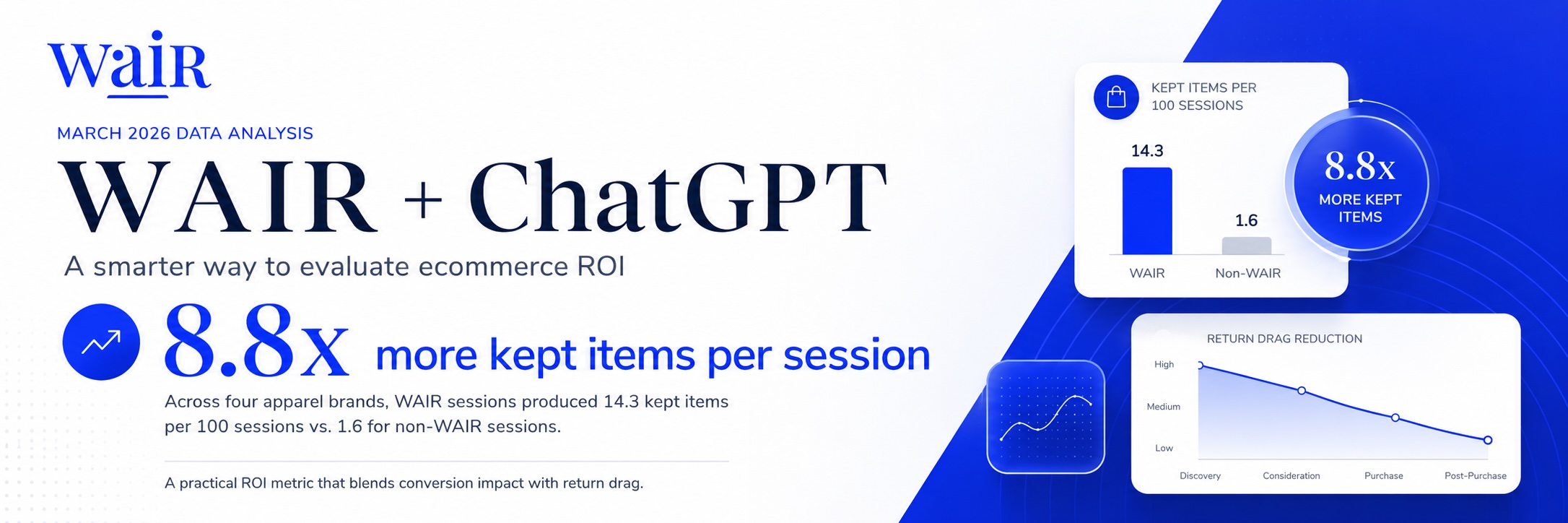
In our March analysis across several anonymized apparel brands, WAIR sessions produced 14.3 kept items per 100 sessions, compared with 1.6 kept items per 100 sessions for non-WAIR shoppers.
That is an 8.8x difference.
This does not mean WAIR deserves full credit for every purchase. WAIR shoppers may already have higher intent. That is an important caveat.
But it does show something meaningful:
WAIR sessions produced materially more retained merchandise.
That is the kind of metric ecommerce leaders should care about.
Four Ways WAIR Helps Make an Ecommerce Store More Valuable
1. WAIR Helps Convert Size-Uncertain Shoppers
Apparel shoppers often do not leave because they dislike the product. They leave because they are unsure.
Size uncertainty creates hesitation. Hesitation creates abandoned sessions. And abandoned sessions create lost revenue.
WAIR helps shoppers move through that moment by giving them a personalized size recommendation based on their body, the product, and the brand’s fit intent.
In the March analysis, WAIR shoppers converted at dramatically higher rates than non-WAIR shoppers across the anonymized brands. When we matched shoppers by brand and new versus returning status, WAIR sessions generated thousands of incremental converted sessions compared with expected non-WAIR conversion rates.
Across the brands analyzed, the observed WAIR conversion rate ranged from roughly 5.1% to 9.3%, compared with expected non-WAIR conversion rates of roughly 0.8% to 1.8%. That translated into an observed conversion lift of approximately 4.1 to 8.0 percentage points, depending on the brand.
Again, this does not mean WAIR deserves full credit for every incremental order. It means WAIR is being used at a commercially valuable moment: when shoppers are close enough to purchase that size confidence can help move them forward.
For ecommerce teams, that confidence matters because it can turn high-intent hesitation into completed orders.
2. WAIR Improves the Quality of Revenue
Not all revenue is equal.
An order that is kept is more valuable than an order that comes back. A product that stays with the shopper contributes more to margin, customer satisfaction, inventory efficiency, and lifetime value.
That is why kept items per session is such a powerful lens.
In the March analysis, WAIR sessions produced 14.3 kept items per 100 sessions, compared with 1.6 kept items per 100 sessions for non-WAIR shoppers.
That is an 8.8x difference.
This metric matters because it accounts for both sides of the ecommerce equation: the upside from completed purchases and the margin impact of returned items. It does not just ask whether WAIR shoppers bought more. It asks whether they bought and kept more.
In other words, WAIR helped generate more retained commerce, not just more checkout activity.
For ecommerce leaders, that is the difference between top-line noise and profitable growth.
3. WAIR Turns Fit From a Cost Center Into a Data Asset
Most brands treat fit as a problem they react to after the sale.
A shopper buys the wrong size. The item comes back. The brand receives a return reason that may or may not be useful. The team tries to identify patterns after margin has already been affected.
WAIR changes that dynamic by collecting fit intent and shopper body data before the order happens.
The March analysis showed that shoppers bought the exact WAIR-recommended size on approximately 66.8% of comparable WAIR purchase line items. By brand, recommendation acceptance ranged from roughly 60% to 73%.
That creates an important layer of intelligence.
Brands can see not only what shoppers bought, but whether they accepted the recommendation, overrode it, reviewed the fit as great, or generated a post-purchase fit signal.
The review data also showed that shoppers who accepted WAIR’s recommendation had a 76.4% great-fit review rate, compared with 73.8% for shoppers who did not fully accept the recommendation.
That difference was modest, but directionally positive. More importantly, it gives brands a structured way to connect size guidance, shopper behavior, fit satisfaction, and downstream outcomes.
Over time, that data can inform product development, merchandising, size curve planning, inventory allocation, and fit strategy.
Fit becomes more than a support issue. It becomes an operating insight.
4. WAIR Gives Brands a More Defensible ROI Story
Many ecommerce tools claim to increase conversion. The problem is that conversion lift is often hard to defend because shopper intent is not evenly distributed.
WAIR shoppers may already be more likely to buy. That is true.
But that does not make the data useless. It means the ROI conversation needs to be more sophisticated.
Instead of saying, “WAIR caused all of these orders,” the stronger claim is:
WAIR helps high-intent, size-uncertain shoppers make more confident purchase decisions, and those sessions produce more kept merchandise.
The March analysis supports that more defensible framing.
Across the anonymized brands, incremental converted sessions outweighed incremental returned orders by roughly 11x to 23x, depending on the brand.
That is the key ROI point.
The argument is not that WAIR deserves full credit for every order. The argument is that WAIR helps brands create more retained merchandise from high-intent, size-uncertain traffic.
Kept items per session brings that story together. Across the brands analyzed, WAIR sessions generated 8.8x more kept items per session than non-WAIR sessions.
That is a more credible and commercially useful ROI story than conversion rate alone.
It acknowledges shopper intent while still demonstrating business value.
The Bottom Line
For apparel ecommerce teams, the goal is not simply more traffic, more orders, or fewer returns in isolation.
The goal is more profitable retained commerce.
That is why kept items per session is such a useful metric. It blends conversion impact with post-purchase reality and gives brands a clearer view of whether a shopping session actually created value.
In our anonymized March analysis, WAIR sessions produced 8.8x more kept items per session than non-WAIR sessions.
That is the kind of ROI signal that matters.
WAIR helps brands convert size-uncertain shoppers, improve the quality of revenue, generate better fit data, and evaluate performance through a more practical ecommerce lens.
Because the most valuable order is not just the one a shopper places.
It is the one they keep.


Want to be notified of our newest episodes?
Subscribe to our Podcast!